




Two types of dryers are used for alfalfa drying: drum dryers and horizontal dryers (often referred to as conveyor dryers, although this is not always accurate). These dryers differ fundamentally in their drying technology, but the key distinctions lie in the quality of the final product and its market value.
Drum Dryers for Alfalfa
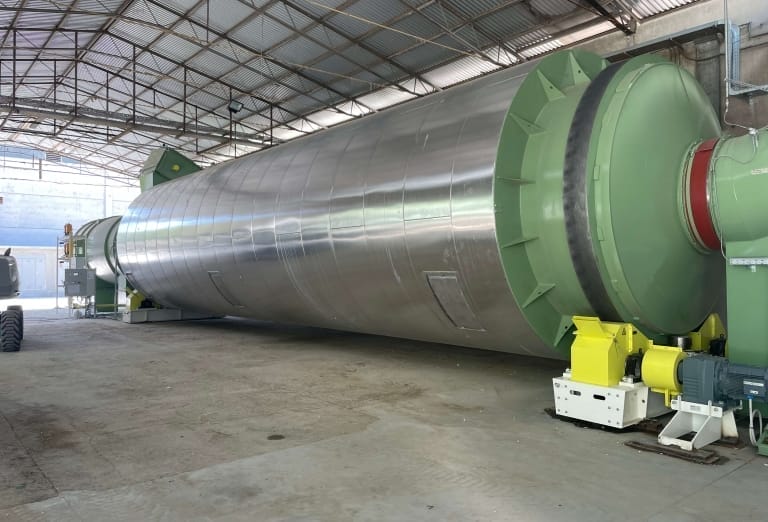
Drum dryers have stricter requirements for the quality of raw material input. For example, while a horizontal dryer can process alfalfa chopped up to 20 cm, it is preferable that the product fed into a drum dryer does not exceed 5 cm in length.
Additionally, the quality of alfalfa after drying in a drum dryer may be somewhat lower compared to horizontal drying technology.
Nevertheless, drum dryers remain popular as they are more affordable than conveyor dryers and represent an older, well-known technology.
Conveyor Dryers for Alfalfa with a Stirring Mechanism

Conveyor dryers provide significantly higher alfalfa quality. This is why they have almost completely replaced drum dryers in Europe, despite their higher cost.
Additionally, conveyor dryers are much more versatile compared to drum dryers.
Although these dryers are equipped with a stirring mechanism, there is no need for concern. They are specifically designed for gentle alfalfa drying, ensuring maximum preservation of quality and protein content. The stirrer features special paddles that rotate in a way that guarantees careful handling of the product and optimal results.
Comparison of Drum and Conveyor Dryers for Alfalfa
But let’s talk more specifically about the advantages of conveyor dryers over drum dryers.

1. Drying Temperature
The fluidized bed technology ensures an even distribution of heat throughout the product mass. Unlike drum dryers, where localized overheating may occur, vibrating dryers prevent shell scorching, preserving its structure and nutritional content.

2. Degree of Chopping
For drum dryers, the product must be chopped to 5–10 cm, depending on the initial moisture content. In conveyor dryers, the allowable fiber length is twice as long—up to 20 cm.
The less the product is chopped, the more protein it retains.

3. Heat Recirculation and Recovery
Some conveyor dryers, such as the Scolari 2T series, feature a two-level design with dual conveyors. Hot air passes through the lower conveyor and is then reused to preheat and partially dry the product on the upper conveyor, reducing gas or other fuel consumption.
Additionally, Scolari also produces three-level dryers in the 3T series, which are highly popular among alfalfa exporters. 3T models maximize the use of hot air, making them particularly beneficial when drying with expensive fuels such as liquefied or natural gas.
Drum dryers are typically not equipped with heat recirculation or recovery systems, making them less energy-efficient.
4. Versatility
As mentioned earlier, conveyor dryers are suitable not only for alfalfa but also for drying a wide range of other products, including:
- Grape seeds and seeds of other fruits
- Pulp and peels of fruits and vegetables
- Various herbs (such as medicinal and aromatic)
- Mushrooms
- Digestate from biogas plants
- Sewage sludge
These are just a few examples of their applications.
Additionally, conveyor dryers are fully adapted for drying all types of grains. Moreover, as previously mentioned, when drying grains, a full hot air recirculation system is implemented, ensuring low drying costs, even for corn.
5. Nutrients
The key factor is maximizing nutrient retention in dried alfalfa. Nutrient loss occurs not only due to the operating principle of drum dryers, which apply mechanical stress to the product throughout the drying process, but also because these dryers operate at high temperatures.
In contrast, conveyor dryers dry alfalfa at lower temperatures (a gentle drying mode), which significantly improves the quality of the final product.
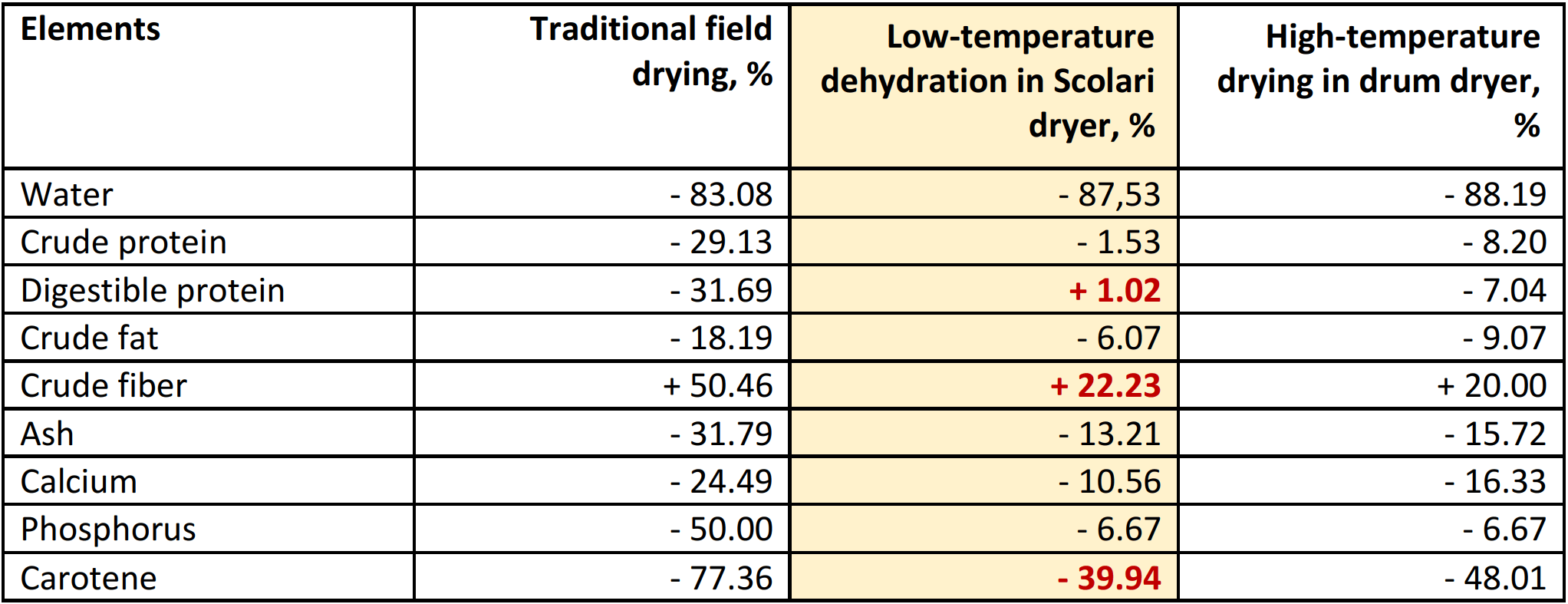
To illustrate this, let’s consider a comparative analysis conducted by the University of Bologna (Italy). The presented data clearly shows that low-temperature dehydration preserves far more nutrients than high-temperature drying in drum dryers. Moreover, the level of digestible protein not only remained stable but even increased.
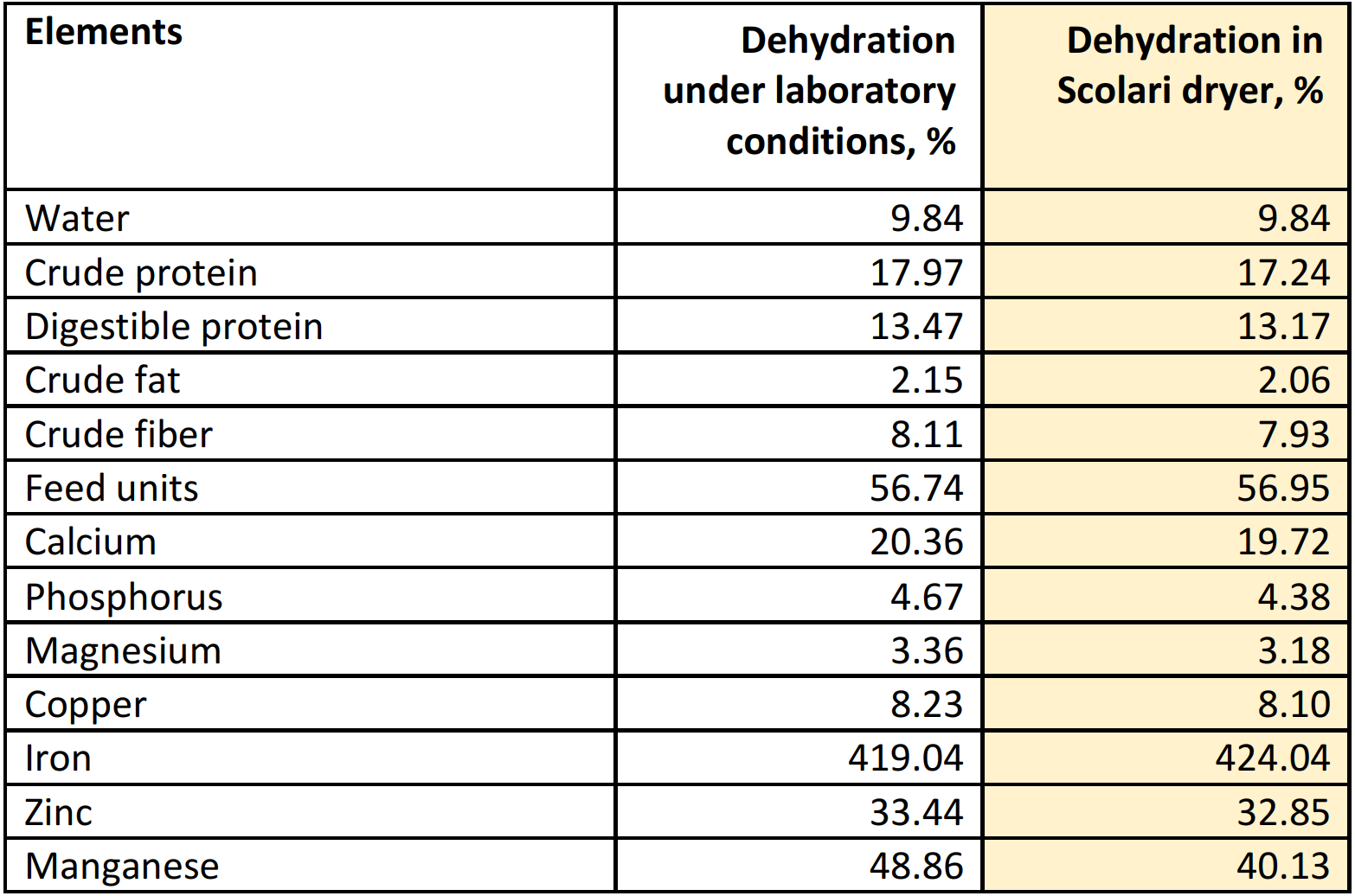
The University of Bologna went even further by conducting a comparative analysis of alfalfa dried under near-ideal laboratory conditions and in a Scolari dryer. The results, presented in the table, show that at the same moisture level of 9.84%, the content of all beneficial nutrients was very close to the ideal conditions. Moreover, some parameters, such as iron content and feed units, even exceeded the results obtained from drying under laboratory conditions.
6. Power Consumption
Drum-type dryers must not only provide a high airflow but also rotate a massive drum. As a result, both the installed and consumed power of such units is significantly higher compared to modern conveyor dryers.
7. Control Over Material Flow
In a drum-type dryer, the product moves from the inlet to the outlet inside an inclined rotating drum under the influence of gravity. As a result, if a portion of the product with non-standard moisture content or physical properties enters the dryer, it may move faster or slower than the rest of the bulk material.
In conveyor dryers, the product rests on the conveyor and moves at a constant speed.